

If you're new here, I run Erudite, the LinkedIn ghostwriting agency that works with Replit, ID.me, Maildoso, and other tech companies.
Over the past three months, we've seen impressions per LinkedIn post decline by roughly 15–35% across our client accounts. But engagement has been stable.
That's our observation from client work. It isn't a platform-wide benchmark, and it doesn't mean every account has lost the same amount of distribution.
If you're publishing useful content and the numbers keep getting smaller, I understand the frustration. We see it too. But the response shouldn't be to panic, buy a pod, or turn every post into a trick for the algorithm.
You need to understand what has changed, what your analytics actually show, and which habits are costing you attention.
The good, the bad, and the ugly
The good: the people who see your posts may still care.
Lower distribution with steady engagement can mean your core audience is still paying attention. For an executive trying to reach a few hundred relevant buyers, that can matter more than being briefly famous with people who will never buy.
It does not automatically prove LinkedIn is sending your content to a better audience. Check who is engaging: their roles, companies, seniority, and whether they fit your ideal customer profile, or ICP.
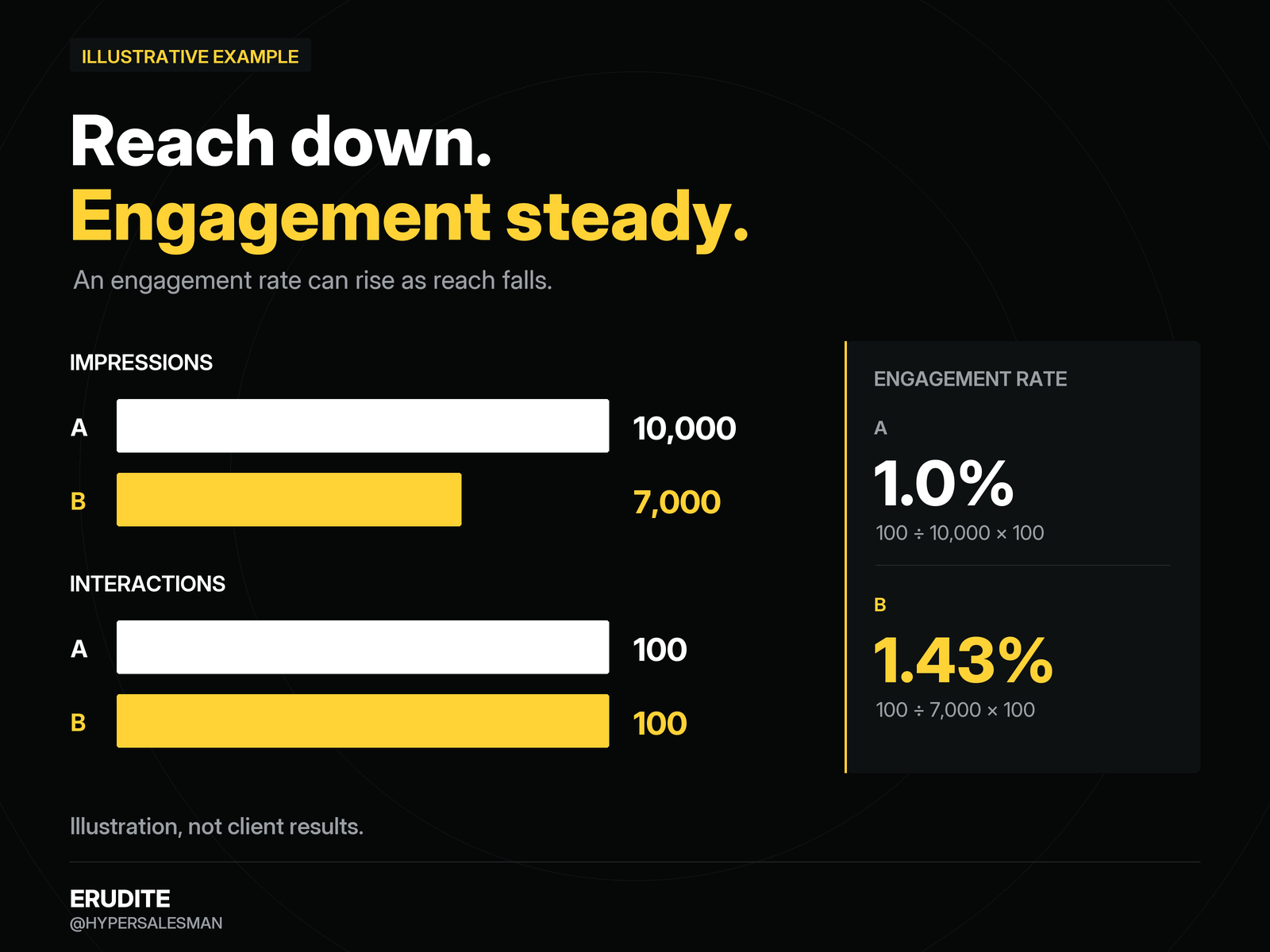
Also separate engagement count from engagement rate. For an illustration, count likes and comments as the interactions. If a post goes from 10,000 impressions and 100 interactions to 7,000 impressions and 100 interactions, its likes-and-comments rate rises from 1% to about 1.43%. The same number of interactions, divided by fewer impressions, produces a higher rate. No extra engagement is required.
The bad: fewer impressions create fewer chances to be discovered.
A smaller audience gives your work fewer opportunities to travel beyond people who already know you. That makes breaking out harder. It doesn't make virality impossible, and a slow first hour doesn't mean a post is finished.
Chasing a viral post is a weak strategy for a business anyway. I'd rather have a relevant founder ask about our work than collect a thousand reactions from people outside our market.
The ugly: familiar faces can hide a distribution problem.
If the same people keep commenting, your feed can start feeling productive while your audience stops growing. A familiar comment section is not evidence that new prospects are seeing you.
Look beyond likes. Are relevant people visiting your profile? Are new prospects connecting? Are conversations starting? Can anyone in sales point to a post that helped a deal move?
Is LinkedIn reducing reach so we'll pay to boost?
Paid distribution becomes more tempting when organic numbers fall. I understand why people connect the two.
But I can't substantiate the claim that LinkedIn deliberately cuts your organic reach to make you buy advertising. LinkedIn says payments don't influence feed distribution except for clearly labeled promoted content. Its published feed update focuses on relevance, authentic interaction, and reducing engagement bait. [1] [2]
Those are the company's statements, not an independent audit of the ranking system. We can measure a decline without claiming to know its commercial motive.
1. Stop using engagement pods.
A pod is a coordinated group that agrees to like, comment on, or reshare each other's posts to manufacture activity. It might make a post look busy. That doesn't mean it is reaching buyers.
LinkedIn explicitly targets engagement pods and automated comments, and its policies prohibit artificially increasing engagement. This isn't a secret workaround the platform hasn't noticed. [2] [3]
For an important launch, it's reasonable to send the post to a handful of people who would actually find it useful. Explain why you're sharing it. Ask for their opinion, not an obligatory like, a scripted comment, or a reciprocal boost.
A relevant friend is a person. A pod is a distribution scheme. Don't turn the first into the second.
2. Be available after publishing. Don't worship the first 15 minutes.
I like publishing when I can participate in the conversation. Answer a real question. Clarify an objection. Give someone the extra detail that didn't fit in the post.
That is good relationship work. A fixed 15-minute deadline for reach is a different claim.
MagicPost's October 6 analysis tracked 28,852 posts from 1,294 creators hourly. The median post had accumulated only 2% of its eventually recorded impressions after 15 minutes, 8% after one hour, and 72% after three days. The final reading was about 40 days after publication for the median post. [4]
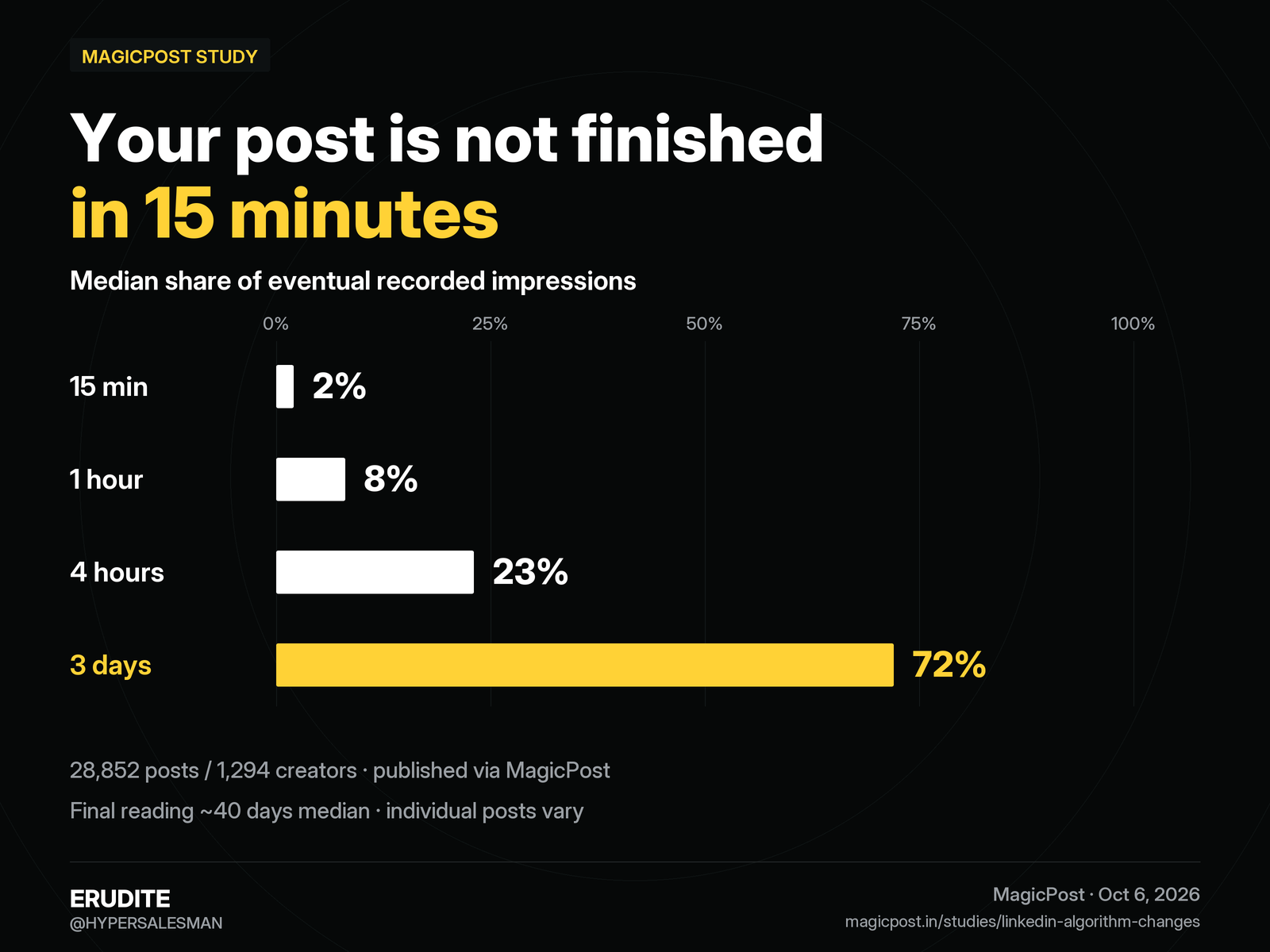
These figures show when impressions arrive; they don't establish which early signals influence later distribution.
Give a post several days before judging it. Recording results at a consistent age, such as seven days, makes comparisons more useful than checking one post after an hour and another after a week.
For timing, start with a few sensible tests: 8 a.m. in your audience's time zone, 6 a.m. Pacific if you're trying to overlap with East Coast mornings, and an end-of-workday slot. Those are test windows, not proven universal winners. Pick a time you can maintain and compare similar topics over several weeks.
3. Vary the format. Keep the point.
Try image posts, plain text, native video, and document carousels. Let the material decide the format instead of stretching every idea into the same template.
In our client work, memes and screenshots have often been strong performers. A screenshot can make a result tangible. A meme can name a frustration the audience already recognizes. Neither format rescues a weak idea.
I wouldn't declare carousels dead. MagicPost's October analysis found their impression advantage over the same creator's photo posts narrowed from 21% to 9%. A smaller advantage is still an advantage in that sample. [4]
Test a specific question: does your audience respond better to a screenshot with an explanation, a short video demonstration, or a document they can work through? Compare qualified responses and useful conversations alongside impressions.
4. Keep the resource. Rethink “comment KEYWORD.”
MagicPost's September 30 study, circulated in its October 6 newsletter, puts numbers behind the decline in comment-based lead magnets.
Across 684,000 posts from 16,000 creators, it found that, since July 27, “comment KEYWORD” posts received 52% fewer impressions and reached 62% fewer people than the same author's ordinary-post baseline. Comments were only 2% below that baseline. Before the break, impressions had been 9% above it. [5]
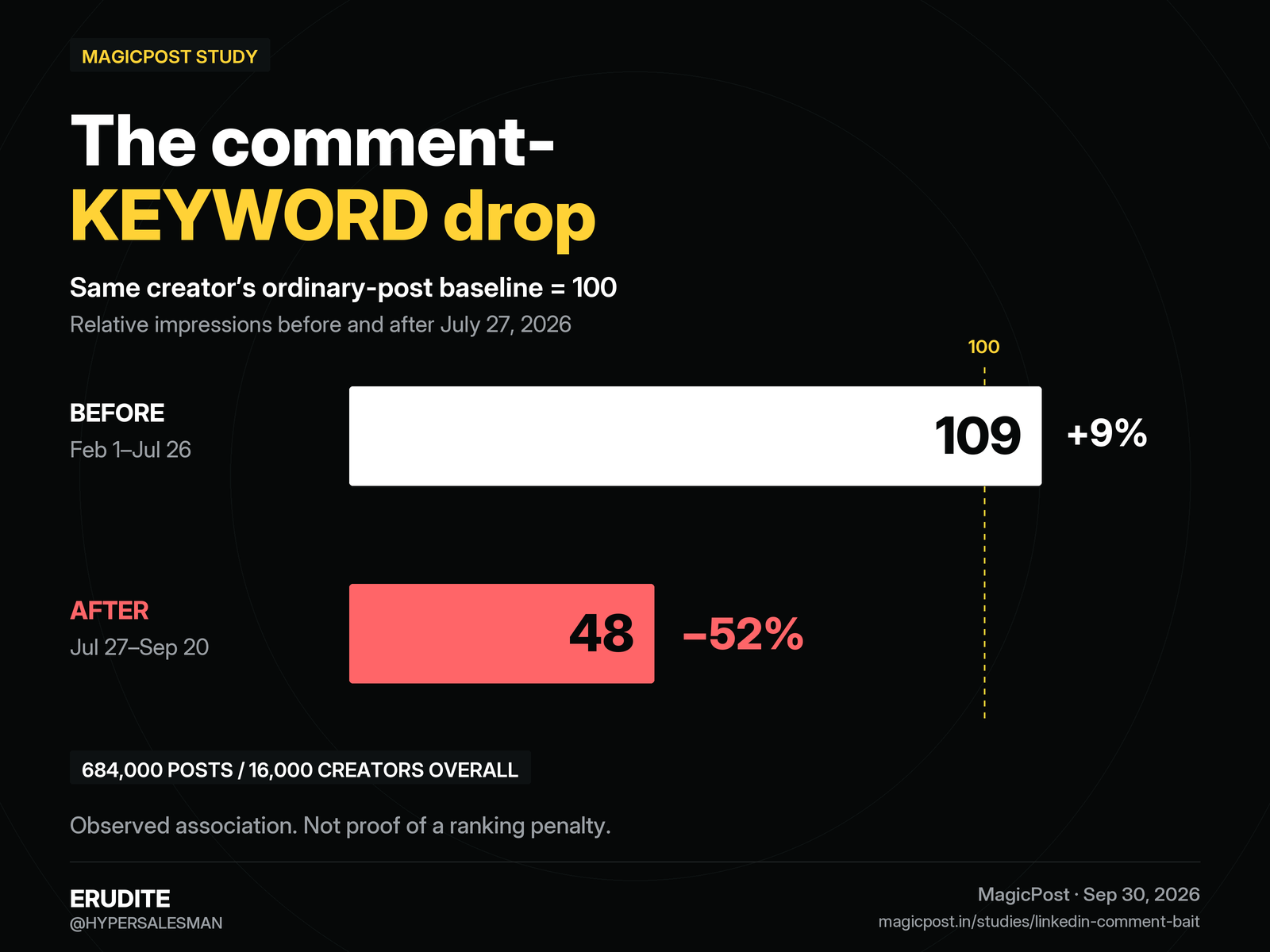
The study excluded company pages and accounts below 100 followers. Its September keyword sample was small, and the authors explicitly say they cannot establish the cause.
That is a useful warning about a distribution tactic. It doesn't prove that useful free resources stopped generating business.
Make the post valuable before anyone gives you a comment. Show an extract, an example, or a useful part of the framework. Offer a straightforward way to get the complete resource. Test the conversion path against actual signups or qualified conversations.
Don't make people perform a public ritual just to discover whether your PDF is worth reading.
5. Stop treating ordinary words like a secret blacklist.
I've heard the advice to replace the two Ls in “killed” with capital Is so the platform won't notice the word. I couldn't verify a reach benefit for that substitution.
LinkedIn's published policies address harmful content and behavior. They do not establish an automatic distribution penalty for this ordinary word in a legitimate business context. [3]
Write clearly. Avoid threats, abuse, and spam. Obscuring the spelling of an ordinary word is not a content strategy.
6. Automate preparation. Be careful about automating people.
There is a meaningful difference between preparing a draft and running software that acts on your LinkedIn account.
Use tools to organize interview notes, build your calendar, prepare visuals, and analyze exported performance data. Review the result yourself.
For account activity, use supported methods. LinkedIn offers native post scheduling, but warns that unauthorized software or extensions that automate activity can lead to account restrictions. That includes more than just comments; unauthorized automated connection requests and messages are not a safe exception. [6] [7]
Send relevant connection requests manually. Write real messages. If your account is restricted, read the notice and review the tools connected to it. Low impressions alone do not diagnose a shadowban.
7. Build relationships with the people you want to reach.
Don't wait for strangers to discover you.
Follow people in your market. Leave comments that add experience, an example, or a useful disagreement. Connect when there is a real reason. Use DMs for a specific conversation rather than a disguised request for engagement.
LinkedIn lists connections, follows, and frequent or recent interactions among its relevance signals. I couldn't verify a public rule that sending someone a DM guarantees your next post appears in their feed. [1]
A thoughtful message can still be valuable because a human being reads it. You don't need an algorithmic promise to justify talking to the right people.
8. Put something in the post that only you could contribute.
Generic advice is easy to produce and easy to ignore.
Replace “understand your customer” with an actual objection from a sales call. Explain a tradeoff you made. Show an approved screenshot. Walk through a failed experiment and what you changed.
LinkedIn says its feed changes are intended to favor relevant professional insight and reduce repetitive, low-substance posts. [2]
For a founder or executive, your advantage is access to work most people haven't seen. Use it. Remove customer names or confidential details when needed; get permission before sharing anything that belongs to someone else.
9. Measure the part of the funnel the post is supposed to help.
A screenshot of a big impression count tells you very little about whether your content is helping the business.
For discovery, track unique viewers, relevant new followers, and profile visits where available. For demand, track resource signups and qualified inbound conversations. For sales support, ask whether prospects mention the content and whether your team is using it in active deals.
Keep the definitions consistent. Impressions include repeat displays; unique reach counts distinct people. Likes and comments are counts. Engagement rate is a fraction whose denominator needs to be stated. Neither a higher rate nor a lower impression count answers the commercial question on its own.
Use a rolling median across comparable posts so one outlier doesn't dictate your strategy. Separate paid activity, format changes, posting frequency, and major changes in topic before blaming the feed.
What I'd do over the next 30 days
- Week 1: Audit the last 20–30 posts. Record topic, format, resource CTA, impressions, unique reach where available, meaningful comments, and relevant inbound conversations. Use the same measurement window.
- Week 2: Remove pods and comment-for-file CTAs. Publish a small set of specific posts built from real client questions, operating decisions, or approved examples.
- Week 3: Test formats around comparable topics. Give the right people a genuine reason to connect or talk to you. Don't change the topic, format, posting time, and CTA all at once.
- Week 4: Review the median performance and the quality of the audience. Keep the approaches that generate useful attention. Retire the ones that only produce a busy-looking comment section.
Lower reach is worth taking seriously. It isn't a reason to abandon the channel or start playing games with your account.
Make the work more specific, get closer to the people you want to serve, and judge the results by what happens after someone sees the post.
Sources and scope
- LinkedIn: Relevance and feed recommendations. Platform guidance; not independent validation of its ranking system.
- LinkedIn: Improving the Feed, March 12, 2026.
- LinkedIn Professional Community Policies.
- MagicPost: LinkedIn Algorithm Changes in 2026, October 6, 2026. Overall sample: 687,000 posts / 16,000 creators, June 2025–September 2026. Its hourly subset is described above. Observational; September posts were still accumulating views.
- MagicPost: LinkedIn Comment Bait Now Gets Half the Reach, September 30, 2026. This is the study circulated in the October 6 email. Baselines use the author's ordinary posts within ±30 days, averaged on a log scale. Its −52% estimate uses a different analysis window from the October 6 follow-up's −47%; the figures here use the September 30 study.
- LinkedIn: Schedule posts.
- LinkedIn: Automated activity.
The 15–35% decline in impressions per post, relatively stable numbers of likes and comments, and performance of memes/screenshots are observations from our client work, not platform-wide benchmarks. Recommendations and the 30-day plan are editorial advice. The engagement-rate example is illustrative.